Opinion
Micah Theard: Man Behind Miracle Cash & More, CashFlow NFT, and Bellator

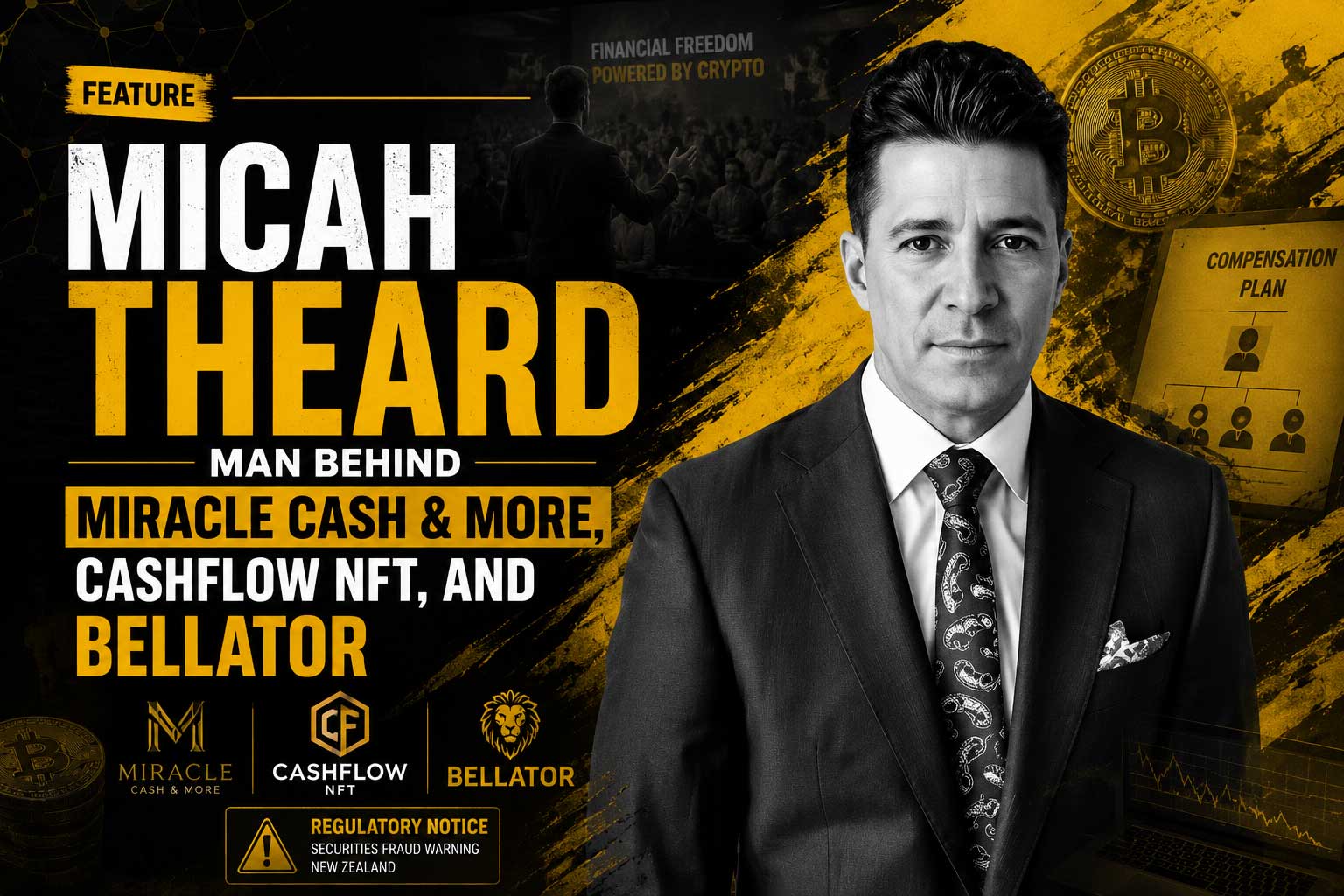
In the world of crypto investment schemes, platforms often vanish as quickly as they appear. When one project begins to struggle, another emerges with a new name, a new story, and a fresh promise. What usually remains hidden is the network operating behind the scenes.
Across the transition from Miracle Cash & More to CashFlow NFT and later Bellator, one name continues to appear with remarkable consistency. That name is Micah Theard.
The importance of Theard’s role is not tied to a single platform. Instead, it comes from his repeated association with multiple ventures that followed a strikingly similar path. While each project was marketed as something new, the underlying structure remained familiar. New branding arrived, but the same network appeared to move forward from one venture to the next.
Long before CashFlow NFT or Bellator entered the picture, Theard was widely reported to have been involved in promoting OneCoin. The relevance of that connection extends beyond history. OneCoin became one of the most notorious crypto fraud cases in the world, built around aggressive recruitment, promotional storytelling, and claims that were never supported by a legitimate blockchain infrastructure.
Those same themes become difficult to ignore when examining the projects that followed.
By 2022, Theard had become associated with CashFlow NFT, a platform that presented itself as a real estate opportunity powered by NFTs. The concept was attractive on paper. Investors were told they could participate in tokenized ownership connected to real world assets while earning passive income through digital investments.
The marketing focused heavily on innovation and emerging technology. Yet questions quickly surfaced regarding the actual assets supporting the NFTs being sold. Independent verification of large scale real estate backing remained difficult to establish. As a result, critics argued that growth appeared to depend far more on attracting new participants than on any clearly demonstrated revenue generating business activity.
As the project expanded, additional ventures began appearing within the same ecosystem. One example was Boogie Gopher Club, which was introduced as another layer of opportunity for participants. These additions created the impression of expansion and diversification. However, they did little to answer the central question of where sustainable value was being created.
The later association with MetaTerra, a company registered in the United States, offered an appearance of increased legitimacy. Even so, concerns surrounding the source of returns remained unresolved.
By early 2024, signs of strain had become increasingly visible. Reports emerged that CashFlow NFT had restricted affiliates from actively promoting the platform. For a business model heavily reliant on recruitment, that development raised immediate questions.
Regulatory scrutiny soon followed. Authorities in New Zealand issued a securities fraud warning connected to the operation. While the warning did not instantly end the platform, it marked another turning point in a pattern that had already been seen before.
Soon after, Bellator entered the picture.
Bellator, sometimes promoted as Bellator Life, was introduced as a fresh opportunity rather than a continuation of an existing one. The branding changed. The messaging evolved. Yet many observers noted that the participant network looked remarkably familiar.
The transition mirrored the earlier movement from Miracle Cash & More into CashFlow NFT. As one platform lost momentum, another appeared ready to absorb the same community. Rather than rebuilding trust from scratch, the network simply carried it forward under a different name.
This is where Theard’s continued presence becomes particularly noteworthy.
His association is not limited to the lifespan of a single venture. His name repeatedly appears at key transition points, precisely when one platform gives way to another. That distinction matters. Many promoters move between opportunities in the crypto sector. Repeated involvement during major rebranding phases, however, raises broader questions about influence, coordination, and continuity.
Direct operational control over these platforms has not been independently established. Nevertheless, the pattern itself is difficult to overlook.
The connections stretch even further back into the Miracle Cash & More ecosystem, which operated through various names including Miracle Technologies Group, Miracle Pay, and Miracle Wallet. Both CashFlow NFT and Bellator have been linked to elements of that earlier network.
Viewed together, the projects appear less like isolated ventures and more like chapters in an ongoing story. The names evolve. The branding changes. The participants largely remain the same.
That continuity is perhaps the most revealing aspect of the entire sequence.
At each phase, the language of the time appears wrapped around the stage. Large-scale crypto narratives came first. In the next phase, the attention was on NFTs. Later still, digital finance and New Ecosystem branding came to the fore. Even though the presentation adapted to the changes in the market, driven recruitment was always the underlying structure, and the recruitment structure showed a lot of familiarity.
Being in an industry that relies on reinvention, Micah Theard has made a name for himself for his persistent presence throughout many phases of many networks that have always been evolving.
His name by itself will not mark the legality or the validity of any one platform. But it does provide a traceable connection to projects that might have otherwise seem disparate. In pursuing the connection, it does show a lack of discontinuity that underlies the constant rebranding.
Ultimately, this story extends beyond any single company or individual.
It is the story of a network that repeatedly adapts to changing circumstances. Miracle Cash & More established the foundation. CashFlow NFT carried it into the NFT era. Bellator emerged as the next iteration.
The names changed. The marketing changed. The narrative changed.
Yet one pattern remained.
And at the center of that pattern, the same name continued to surface.